I’m super excited to preview a new product integration coming from OpenBOM for the construction business, which is part of what we developed at AECBOM. The idea of AECBOM is to use all available OpenBOM services and contextualize them for the construction industry. If you missed what we did previously, check some of our earlier articles:
- AECBOM for Autodesk Revit: Takeoffs and Embedded Browser
- Digital BOM for AEC and intelligent bi-directional data exchange with Autodesk Revit
This integration benefits project managers, architects, engineers, and contractors by providing an efficient, comprehensive solution for managing project information. It can enhance productivity by eliminating the time spent searching for information in complex models. It also facilitates more accurate cost estimations, which is critical for successful project completion within budget.
The AECBOM integration we build for Autodesk Revit is focusing on streamlining information flow for architects and contractors working mainly on electrical, mechanical, and HVAC projects. AECBOM is not limited to these fields, but this is where you can see the biggest value of AECBOM delivering information and helping to get the right data from Revit projects.

AECBOM for Autodesk Platform Services (Forge)
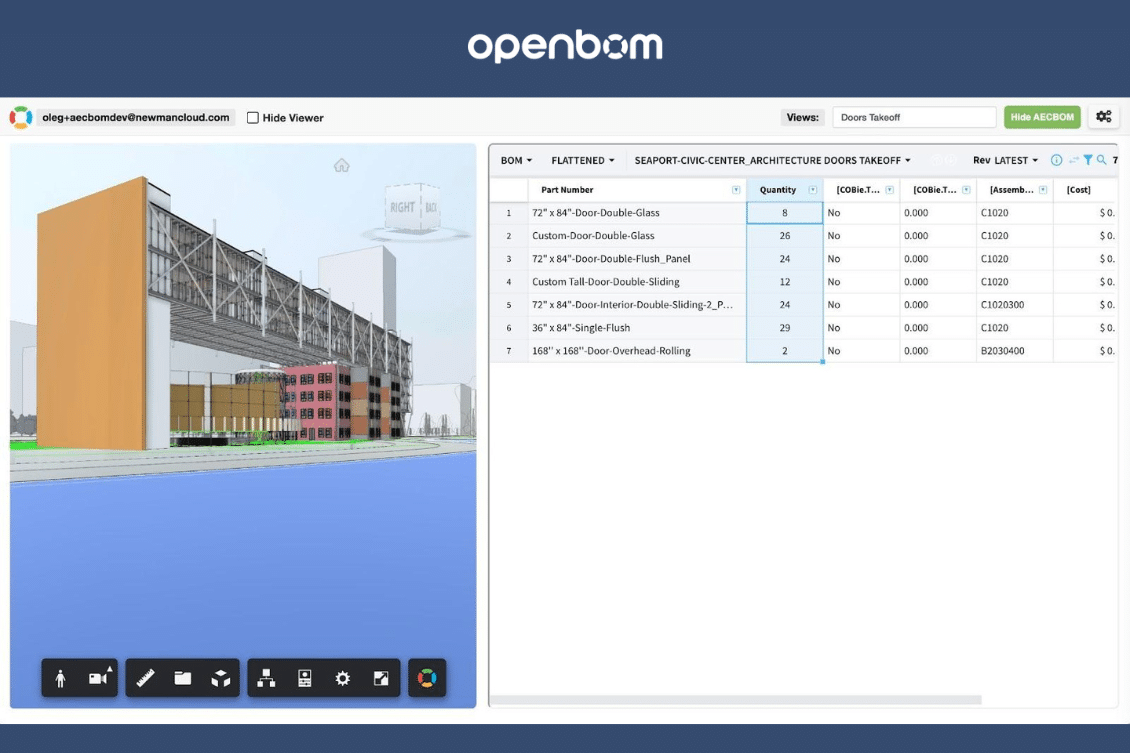
The new integration embedded within the browser interface provides seamless access to Autodesk APS viewer. This viewer allows a detailed and immersive visual examination of the Revit model’s elements. Users can explore their design in depth, rotating, and zooming to scrutinize every aspect and detail, thus providing a comprehensive understanding of the project’s design.
The integration’s unique feature is its ability to extract specific elements of the Revit model automatically. The extraction tool identifies and retrieves the properties needed from the Revit model, significantly simplifying the data acquisition process. Architects, engineers, and contractors can now easily access the information they require without having to navigate through the entirety of the complex models.
Moreover, the integration generates specially tailored views that enhance the understanding of the model. This new feature will be of particular interest to those involved in cost estimation and quantity surveying, as it delivers Takeoff tables for all Revit object types in the model. Takeoff Tables are crucial in preparing cost estimations, providing a detailed list of materials, quantities, and measurements required for the project.
The integrated platform’s power lies in its streamlined workflow and the ability to handle complex models and large data sets, making it an essential tool for large-scale, complex projects. It leverages the powerful capabilities of both AECBOM and Autodesk Revit, providing a holistic approach to construction project management.
Video Demonstration
The integration of AECBOM with Autodesk APS (formerly Forge) is the way for professionals in the AEC industry, to simplify and streamline data access. It is bridging the gap between the complexities of construction design and purchasing and ordering process. It gives construction projects a streamlined, efficient, and holistic approach to the ordering process.
Watch the video to learn more about the coming AECBOM feature.
Conclusion:
The integration of AECBOM with Autodesk APS (Forge) offers a way for super simple capabilities and efficient data extraction for construction work. It streamlines data coming from Revit models in the way of takeoffs for purchasing and ordering. By combining the powerful capabilities of Autodesk Revit and AECBOM, architects, engineers, and contractors can now manage their projects easier and always get access to the right data at the right time. Which allows to them deliver projects faster.
Contact OpenBOM to learn more about AECBOM products and services.
Best, Oleg
Join our newsletter to receive a weekly portion of news, articles, and tips about OpenBOM and our community.