

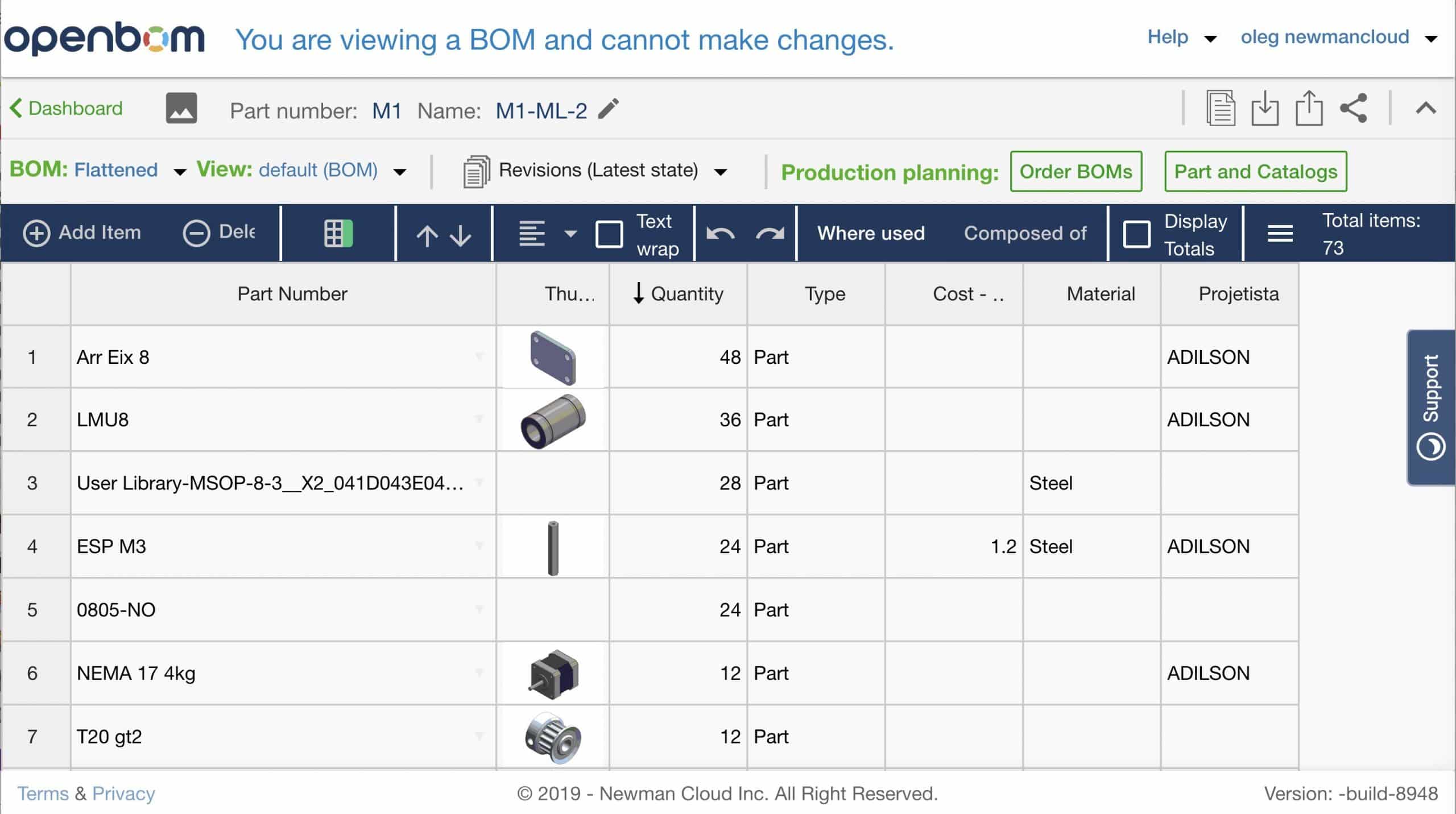
To manage parent-child relationships is a fundamental function in the Bill of Materials. OpenBOM does it on demand by connecting Part Numbers. It is a very useful function that can apply in many situations. You can think about complex structure, order or anything like this.
While Multi-level BOM is a structure, you can think of a flattened BOM as a list of all the parts from all levels of your BOM listed together and the aggregate total quantities for each part are shown. It’s a great way to see the quantities of ALL Parts (no matter what level of the BOM they appear) with their summed quantities.
Flattened really only makes sense for a multi-level BOM. The following picture can give you an idea about what is flattened BOM:
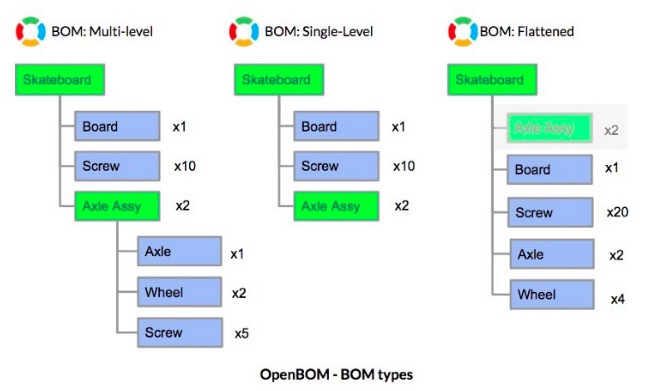
Think about simple skateboard combined of board, screws, axle, wheels and more screws. Altogether, you can see them organized in an assembly (Skateboard) and subassembly (Axle Assy). However, when you get to a single-level BOM, you will see only one level including Parts and next level assemblies. The purpose of the Flattened BOM type is to display a flat representation of your BOM with distinct components and corresponding quantities collected from all sub-levels of a specific assembly.
The following video gives you a very short demo of flattened BOM in OpenBOM
Conclusion
OpenBOM Flattened BOM is an out-of-the-box quantity roll-up mechanism that can be used practically in any BOM structure. OpenBOM creates parent-child relationships on demand by connecting BOMs using Part Numbers (ID). Note- it CAD integrations it is the file name. By using Flattened BOM, you can get a summary of parts and their quantities in ANY product structure.
Best, Oleg
PS. Let’s get to know each other better. If you live in the Greater Boston area, I invite you for a coffee together (coffee is on me). If not nearby, let’s have a virtual coffee session — I will figure out how to send you a real coffee.
Want to learn more about PLM? Check out my Beyond PLM blog and PLM Book website
Join our newsletter to receive a weekly portion of news, articles, and tips about OpenBOM and our community.


