Depending on your industry, outsourcing production can be an attractive option. Companies of all sizes turn to outsource their production to suppliers or a contract manufacturer (CM) for a number of reasons. However, is it the right option for you?
To help you figure out whether you need to outsource production, here are the top reasons why companies decide to outsource production:
Costs
There are a number of reasons why outsourcing production will be the cost-effective option. The most common reasons are because of their lower overhead costs and because of their lower labor costs.
If you start your own production line, you will need to purchase all of the machines, find space, hire employees, and everything else to manage and sustain your production facility.
Another way you reduce costs is by outsourcing production to a country with cheaper labor. Outsourcing provides a cost-effective solution by saving production labor costs.
Scaleability
When you have spikes in demand, you can quickly turn to your supplier and ask them to produce more products for you. Also, if you are growing, you do not need to worry about increasing your own production operations, you just need to make sure your supplier can support your growth.
If you do not expect to grow or if you manufacturer one-off projects, then it will be more difficult for you to find suppliers willing to work with you, and creating your own in-house production line might be necessary.
Knowledge
When you select a supplier you will gain the knowledge they have acquired throughout the years. This will come in handy when the following occurs:
- Quality Problems
- Development Projects
- Material Selection
- Cost Down Projects
If you are developing new technologies, setting up your own production facility might be necessary because you own the knowledge and IP of that product.
Improved Efficiency
If you outsource production, your overall efficiencies will increase. When you have an in-house production line, you will also need to expand your IT department, HR services, and most likely your accounting capabilities.
You will be forced to hire people, train them and make sure there is enough work to keep them and keep them efficient.
How OpenBOM Can Help?
To have a reliable set of information about the product is a foundation of your success with the outsourcing process and contract manufacturing. You should be able to seamlessly pass the information from your engineering and manufacturing teams to contractors. Without such control, your outsourcing provider will work on the wrong data.
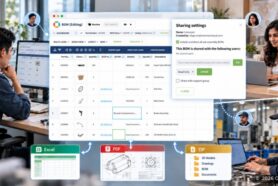
OpenBOM improves the process of how you work with your CM, contractors, colleagues, and other team members. We provide you with the capabilities to seamlessly manage your parts, vendors, bill of materials, purchase orders, and change orders. All BOM, engineering, and manufacturing information are stored in the cloud which you can share with anyone.
Register for FREE to create your OpenBOM account and reach out to us via support @ openbom dot com if you have any questions.
Regards,
Jared Haw
Join our newsletter to receive a weekly portion of news, articles, and tips about OpenBOM and our community.